


Uflex recently commissioned its new pyrolysis plant at its packaging division in Noida. The first ever pyrolysis process plant in North India, the new pant will not only protect the environment by converting plastic wastes into energy but also nurture a healthier tomorrow. The pyrolysis plant once again reaffirms Uflex’s commitment towards a greener future through economically viable solutions for handling plastic waste in the society. Pyrolysis process works as a sustainable waste to energy technology with an ability to handle any plastic waste.
At its pyrolysis plant, Uflex converts about six tonnes of discarded waste material generated everyday from printing, unused trim, laminates, tubes and other unprocessed material into liquid fuel, hydrocarbon gas and carbon black which is further utilized in its manufacturing processes.

“After the Government’s Plastic Waste Management Rules, 2016, which call for comprehensive overhauling of plastic waste management systems, we started our own recycling plant. However, there are certain wastes which cannot be recycled. Event if you recycle it, you cannot produce any usable products. So, we now put those waste into the pyrolysis process and produce different forms of fuels – light distillate oil (LDO), hydrocarbon gas and carbon black,” said SS Parmar, senior vice president, Energy Group, Uflex.
Pyrolysis plant generates 2,000 liters fuel daily
Uflex consumes nearly one lac liters of fuel daily to run its generators, industrial boilers and furnaces at its Noida plants. “The new pyrolysis plant generates nearly 2,000 liters of fuel daily which is just a small fraction of what our plants actually require. But that doesn’t dissuade us from running the pyrolysis plant because our primary goal is to have a process in place for effective management of the waste that otherwise cannot be recycled,” said Parmar.

Pyrolysis process
In this process, the polymer waste stored in the raw material facility is taken to a shredder which is cut into smaller pieces and then fed into the air lock feeding system. The waste material is chemically decomposed at elevated temperatures in the absence of oxygen. This reaction takes place inside the pyrolysis reactor and occurs at temperatures ranging from 430 to 500 degree Celsius. Thereafter, the pyrolysis reactor converts the polymer waste into pyrolysis oil, hydrocarbon gas and carbon black powder in the ratio 45:45:10 respectively. Mixture of pyrolysis oil vapor and hydrocarbon gas exits the pyrolysis reactor and is subjected to fractional condensation to get separate fraction of hydrocarbon gas, pyrolysis wax and pyrolysis oil. Pyrolysis wax is fed into the reactor for further reprocessing.
“While we use the oil to run our industrial boilers, 75% of the hydrocarbon gas produced in the process is used for running the boilers within the pyrolysis plant for heating the plastic waste. The remaining gas is used for the multi stage evaporation plant within our premises. This is basically to vaporize the dirty water – high total dissolved solids (TDS) – generated by effluent treatment plant, which comes out of the RO plant where you get 90% good water and 10% rejected water. Since throwing away of this rejected water is not safe, it needs to be vaporized. Some residues may still exist which can be used in landfills,” explained Parmar.
“Carbon black powder is cooled and packed into bags for further use as solid fuel. It has a calorific value similar to coal. One may burn it in PET coke fired steam boilers, firewood boilers or other similar boilers just like any other solid fuel,” added Parmar.
New machine for MLP recycling at IndiaPlast 2019
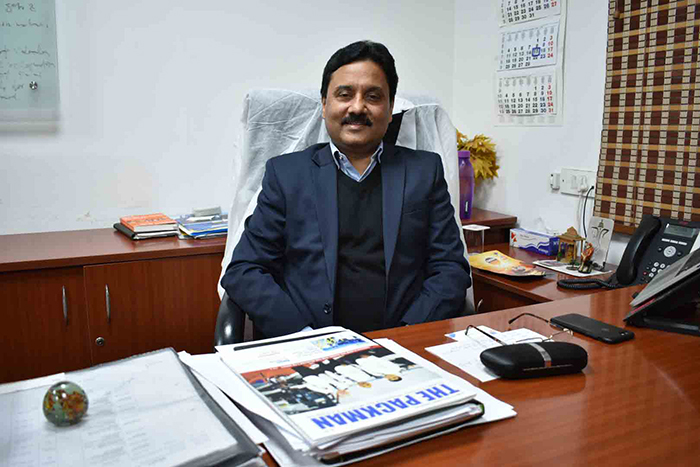
“We have been involved in plastic recycling since 1995. Today at our Noida plant, we recycle six tonnes of plastics daily. The plant has two machines for recycling plastics such as PP, PE, BOPP, and BOPET into reusable plastic granules. Recently, we have developed a machine that can recycle multi-layered plastics (MLP) as well,” said Anil Maitraya, senior general manager, operations, Packaging Division, Uflex.

“It is difficult to recycle MLP because the polymers involved in different layers have different melting points. The challenge is to bring these multi layers to a homogeneous form which can be melted homogeneously to flow together and form recyclable pallets. We have partnered with a company to develop a compatibilizer which can bring all these material to a coupling bond so that they can be melted on a single temperature. We will exhibit this machine at IndiaPlast 2019, Hall 14 Stand B1,” concluded Maitraya. IndiaPlast 2019 will be held between 28 February and 4 March at India Expo Center, Greater Noida.